Running SEO for a whole network of sites like a 10-person agency — with agents
I run SEO for a network of websites the way a ten-person agency would — except it's a fleet of agents on my own hardware, and it runs every day without me. SEO is mostly not a creative problem; it's a relentless, detailed, never-finished maintenance problem. Which makes it almost perfectly suited to a coordinated set of AI agents that never get bored.
SEO is a hundred small chores, forever
The reason SEO feels overwhelming for a solo operator isn't that any one task is hard. It's that there are dozens of them, they apply to every page, they're never done, and skipping them is invisible until rankings quietly slide. Structured data. Sitemaps. Alt text. Internal links. Canonical tags. Title and meta hygiene. Finding the pages that are almost ranking and nudging them over. Doing that once is tedious; doing it continuously across many sites is a full-time job nobody wants.
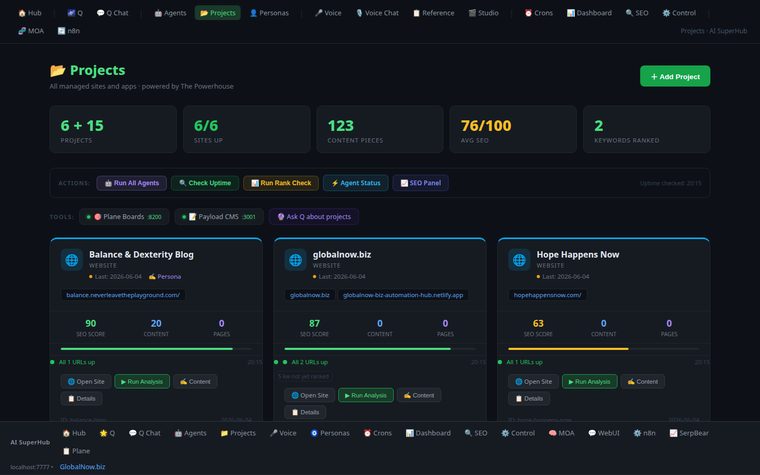
So I handed it to agents, each with a specialty, coordinating through shared memory so they build on each other's work instead of duplicating it.
What the SEO fleet actually does
- Rich structured data on every page so search engines can show the good stuff — video, course, and review-star snippets — instead of a plain blue link.
- Sitemaps and crawl hygiene kept current automatically as pages come and go, so nothing falls out of the index silently.
- A unified navigation layer so every property in the network links sensibly to the others — internal linking that would be a nightmare to maintain by hand.
- Striking-distance hunting — finding keywords already ranking on page two, one nudge from page one, and improving the exact pages that will move. This is the highest-ROI work in SEO and it's pure data crunching.
- Competitor analysis on the terms I care about, so I know who's ahead and what they're doing.
- A content calendar that plans what each site should publish, feeding the publishers that write it.
Real data in, prioritized action out
The part that makes it more than a checklist is that it runs on real numbers. It pulls actual search performance — clicks, impressions, click-through, average position — and feeds that into the agents that decide what to fix. So the system isn't optimizing in the dark against best-practice guesses; it's looking at "this page gets impressions but no clicks, and it's sitting at position 11," and acting on that specifically. The auto-fixer produces a prioritized list aimed at the pages where a change will actually matter, not a generic audit you'll never finish.
The hardest thing it did: a structural migration
The most ambitious SEO work wasn't day-to-day — it was restructuring how a whole site was organized for search, moving a large set of pages from a scattered layout into a clean hierarchy, with proper permanent redirects so no ranking or link equity was lost in the move, and resubmitting everything so search engines could re-map it. That's the kind of project an agency scopes as a multi-week engagement. Doing it carefully — every redirect verified, every old URL still resolving to the right new one — is exactly the meticulous, error-prone work that machines do better than tired humans, as long as you build in the checks.
And of course it verifies: after changes go live, it confirms the live pages actually respond correctly, the same publish-and-verify discipline I apply everywhere. A migration that "should" work and a migration you've confirmed page-by-page are very different things.
Why a network, not a site
Managing one site's SEO is a hobby. Managing a network's is where the leverage shows up — shared keyword intelligence, cross-linking that lifts everything, one content engine feeding many brands, competitor data that informs all of them. A solo person simply can't keep that many plates spinning by hand, which is precisely why most solo operators never build a network. The agents make the network tractable.
If you take one idea from this: SEO rewards consistency far more than brilliance, and consistency is exactly what humans are worst at and software is best at. Point patient, coordinated automation at the boring 90% — the schema, the sitemaps, the internal links, the striking-distance nudges — and reserve your own attention for strategy.
That whole-network SEO engine is part of the platform I'm building — a self-hosted AI workforce that manages an entire web property like an agency would, on your own hardware. I'm building it in the open, and the SEO fleet is one of the clearest examples of agents quietly compounding value while I sleep.
Run autonomous agents for SEO, content, and publishing — on your own hardware.
Join the Waitlist